
Body Alignment through Breathing
Our aim in this text is to examine how we perceive alignment today. In order to develop our line of thought, we will “connect” with our recent past, within the framework of Western civilization and within the space and time in which we live.

Initially
In almost all exercise, arts, and therapeutic techniques, and more generally in studies of the human body, we talk about “body alignment,” which usually refers to the upright positioning of the body or certain of its parts.
We can observe that the term “body alignment” has been interpreted and applied in different ways over the years, depending on how people perceived and approached their bodies in each era.
One could conduct an extensive study of human body alignment in relation to culture and historical period—a study that would lead us deep into the centuries, to the moment when humans began consciously exploring the expression of their bodies in athletic or artistic contexts.
Our goal, however, is to examine how we understand alignment today. To develop our perspective, we will ‘connect’ with our recent past, within the framework of Western culture and within the space and time in which we live.
The Two Approaches
At the beginning of the 20th century and until approximately its middle, one could argue that the era of “stretching” the body dominated. From photographs of gymnastic demonstrations or other physical activities (sports, dance, etc.) of the time, we can see that attempts at body alignment were based on dynamic stretching. The body extended intensely, creating a sense of tension—a sort of inward force—often expressed through hyperextensions of the joints, spine, or limbs. Today, remnants of this alignment approach can be observed in the military attention stance, in hyperextended limbs, in female gymnasts, or in certain classical dancers.
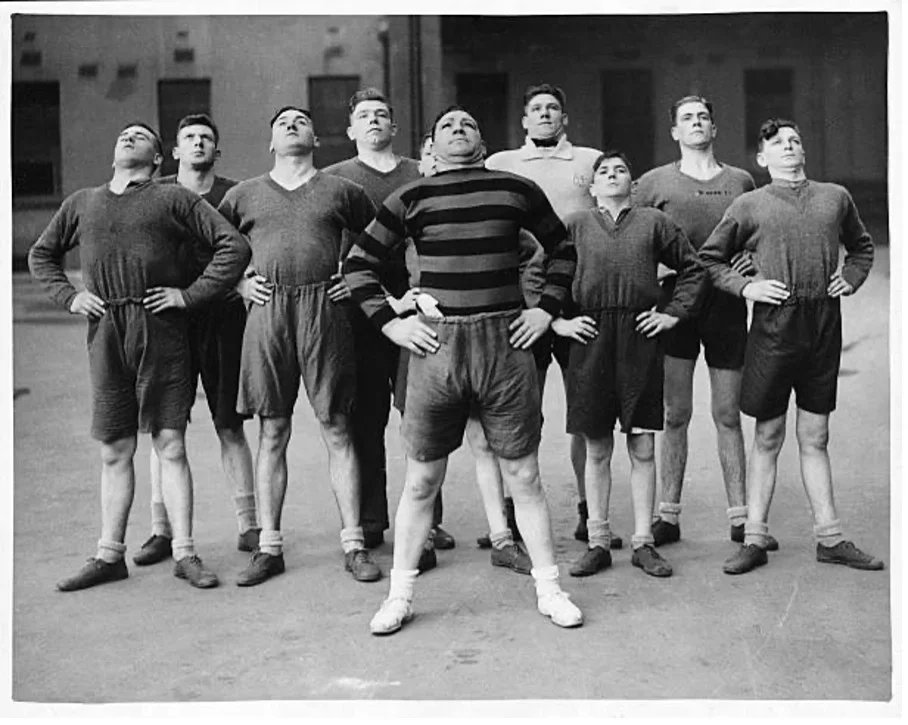

20th century
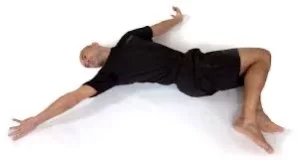
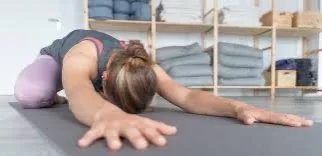
Around the mid-20th century, the era of “lengthening” the body emerged. In this approach, the individual usually focuses on two points of the body and attempts to distance them from each other. For example, by imagining the head moving away from the coccyx, one “lengthens”—aligns—the spine; by imagining the fingertips moving away from the shoulder blades, one “lengthens”—aligns—the arm, and so forth.
In this case, alignment is expressed as tension rather than strain, and the joints are no longer hyperextended but rather “lengthened.” In other words, all the ligaments and soft tissues of the joint are in a state of uniform, homogeneous stretching. Furthermore, while the first alignment approach was purely physical, the second is more introspective: one “imagines” the mental line connecting the coccyx to the head.
In the “stretching” approach, one could liken the body to a crumpled piece of fabric: attempting to smooth the folds, one presses from above, reducing their thickness but not eliminating them.
In the “lengthening” approach, using the same analogy, the folds disappear because the fabric is stretched outward from its edges.
It is clear that the first approach gives rise to anatomical issues: the joints often hyperextend and “lock,” restricting mobility and raising questions about their healthy, natural function. In the second approach, this problem does not arise.
Social and Cultural Context
It is important to emphasize the social and cultural context in which these two alignment trends developed. While our goal is not to conduct a detailed analysis, a brief reference will help us better understand the kinesiological aspects of these approaches.
The first approach (“stretching the body”) emerged in a period when humans felt the need to demonstrate strength. Just a century earlier (the 19th century), with the Industrial Revolution, humans had begun to develop technology, excel, and manage their environment effectively. Observing the body form during alignment of this era, we see the body dynamically extended, chest projected outward, and all joints hyperextended. This approach reflects a focus on the self and the display of power in early 20th-century humans.
The second approach appears more communicative. The person “lengthens” the body, extending outward and attempting to connect with the environment. It is perhaps not coincidental that this approach emerged when humanity was still reeling from World War II—a period in which society was re-evaluating the values that had brought it to that point. People sought to perceive themselves as integrated into their environment and to learn from it. Likewise, it is perhaps no coincidence that modern ecological and environmental movements began emerging around this period.
The first approach (“stretching the body”) is now considered outdated, particularly due to anatomical issues related to joint locking and the overall handling of the body. The second approach has persisted to the present day. In nearly all movement practices, when addressing body alignment, the metaphorical instruction “lengthen your body” is now understood as an alignment principle. Mentally “connecting” a body part with a point in the surrounding space adds a qualitative dimension to alignment (e.g., “connect your feet with the floor or the Earth” and “your head with the ceiling or the sky”).
Nevertheless, the question arises whether this alignment approach is still appropriate today, and whether it, as a method, fully addresses all the information the individual can access or experience during alignment. To answer this, we must consider the social and cultural context of our era, the way we consciously perceive our body today, and the investigative capacity humans have developed regarding themselves and their environment. From this perspective, we can make certain observations that may lead to substantive conclusions.
Three-Dimensional Perception
Examining the “lengthen the body” approach, we realize it is initially a visual-imaginative process. We imagine the coccyx, create a mental image of it and its surrounding area; then we imagine the top of the head and mentally separate the two points. In this process, the body is treated two-dimensionally, since the separation of two points along a straight line is, geometrically, a two-dimensional action.
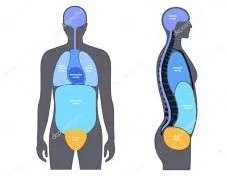
Thus, although in daily life we perceive our body three-dimensionally in space, when processing alignment of the body or its vertical axis, we often rely on a two-dimensional perspective. This approach neglects the body’s internal “spaces,” namely the cavities of the pelvis, abdomen, thorax, and head.
This is not problematic unless certain practical issues arise, which the two-dimensional approach cannot address. These occur when the body at rest tilts laterally in the pelvis, thorax, or head, or when the pelvis, thorax, or head are rotated or displaced anteriorly or posteriorly relative to the vertical axis.
Often, lifestyle, body management habits, or past injuries result in unevenly trained muscles. Consequently, small or large anterior or posterior tilts of the pelvis, flexion or hyperextension of thoracic or cervical vertebrae, lateral tilts, rotational positions, or anterior–posterior displacements of the pelvis, thorax, or head can appear.
The two-dimensional “lengthen the body” approach—stretching a mental line—can help study anterior or posterior tilts and extensions. However, it is completely ineffective for lateral tilts, rotational positions, or anterior–posterior displacements, which require consideration of the internal spaces created by the body.
Curved Lines of the Body
The “lengthen the body” method is a process of aligning the entire body or its limbs, essentially placing the body in a “straight line.” Anatomically, however, no bone or organ forms a true straight line. The body consists entirely of curved lines, cavities, and ovoid or spherical structures. Hence, the notion of “alignment” becomes limited.
A more suitable term might be “upright body positioning.” This term emphasizes a straight “tension” rather than literal lines, shifting perception from linear placement to the dynamic aspect of the body—guiding its energy.
Displacement and Communication
Although we agreed to limit historical references to the relatively recent past, one cannot ignore ancient Greek sculpture. In Cycladic works and the kouroi and korai of the Classical period, upright body positioning carefully considers volume. Through curves and volume, sculptures express not only upright dynamism but also the internal space of the body.
As a result, observers perceive the sculpture’s displacement—a set of sensations and information generated while viewing it. This kind of communication, created between a body aligned through its volumes rather than a simple line and an observer, is also observable in actors or dancers consciously working with their body.
All body-related arts rely on this communication: the displacement the artist generates through successive alignments of the body’s volumes in space and the sensory-information response elicited in the observer. Similar observations can be made in everyday life: two well-trained people may both appear upright, yet their spatial positioning creates entirely different impressions.
Conclusions
These observations lead to further inductive insights.
First, imagine observing the alignment of your body’s internal spaces. Alignment study is no longer merely geometric; it becomes a “bank of information” arising from sensations, experiences, and introspection.
Second, although alignment methods present a typical application pattern theoretically accessible to everyone, bodies aligned in the same way will never appear identical—they will not convey the same displacement or impression.
This suggests that alignment is a living, dynamic process occurring in a living body. We cannot overlook that the basic sign of life is breath. Thus, in alignment—or more accurately, upright body positioning—breathing is a fundamental, active element.
The relationship between upright body positioning, internal spaces, and breathing introduces a new realm of body perception and control. All traditions, arts, and methods addressing the body from this perspective refine and elevate their techniques, reaching deeper insights.
From these observations, we can deduce that for upright body positioning of the body or its parts, the following parameters must be considered:
- Alignment involves not only the vertical axis and anterior-posterior tilts, but also lateral bends and rotations.
- The body consists of curves; thus, straight lines do not exist.
- Studying alignment requires three-dimensional perception rather than a two-dimensional one.
- Internal spaces formed by bones must be considered, as well as the displacement the body projects into space.
- Finally, breathing is a vital factor, imparting a living, dynamic quality to the process.
A fundamental feature of humanity throughout history is the ability to observe, create tools to process what is observed, and thereby develop perception.
When perception reaches a new stage, previous tools become inadequate, prompting a new cycle: observation, invention of tools, conscious perception, and development at an even higher level.
Applied to the human body, our perception has expanded significantly in modern times. The body is no longer seen merely as a collection of cells but as a holistic entity that emits material, emotional, and cognitive information when active.
Across therapeutic, exercise, and expressive domains, the body is studied as a whole, with perception functioning introspectively.
Our current perception can apprehend more and higher-quality information than previous stages. This explains why alignment using the “lengthen the body” approach alone is now insufficient.
Let's Talk
Sp. Patsi 69, Votanikos-Gazi3rd floor 11855 Athens
info@horosyoga.com
210 341 4547 - 69 4606 1264